
Call us now :08045479896
 Send Inquiry
 Send Inquiry
CUT SECTION MODEL OF TWO STROKE SINGLE CYLINDER DIESEL ENGINES
MOQ : 1 Unit
CUT SECTION MODEL OF TWO STROKE SINGLE CYLINDER DIESEL ENGINES Specification
- Assembly
- Pre-assembled, ready to use
- Surface Finish
- Smooth, powder-coated and polished
- Power Type
- Non-functional demonstration (manual movement)
- Features
- Manual crank movement, color-coded sections, labeled parts, durable construction, compact design
- Use
- Demonstration and teaching of two-stroke diesel engine operation
- Style
- Educational cut section model
- Model No
- TCM-2SD-01
- Size
- Standard lab scale
- Weight
- Approx. 12 kg
- Type
- Single cylinder, two-stroke diesel engine model
- Material
- High-grade metal alloys and engineered plastics
- Dimensions
- Approx. 45 cm x 30 cm x 40 cm
- Shape
- Engine block with cut section detailing
- Color
- Multi-color (internal parts highlighted for clarity)
- Function
- Display of engine parts and working mechanism
- Age
- Suitable for students above 14 years (technical education)
- Advantage
- Visually demonstrates engine internal structure and working principles
- Port Type
- Transfers and exhaust ports are visible
- Moving Parts
- Piston, connecting rod, crankshaft (manual demonstration)
- Ignition System Representation
- Model includes injector to illustrate diesel process
- Demonstration Mechanism
- Hand crank to simulate piston and crankshaft movement
- Exhaust and Inlet Display
- Clearly marked exhaust and inlet passageways
- Cylinder Configuration
- Single cylinder, vertical mount
- Lubrication Simulation
- Shows basic lubrication pathways (non-functional)
- Stand Type
- Mounted on a stable demonstration base
- Teaching Suitability
- Ideal for mechanical, automotive, and vocational training institutions
- Model Durability
- Impact resistant, corrosion protected metal parts
- Section View
- Cut section to show piston, crankshaft, inlet/exhaust ports, injectors
- Detail Level
- Accurate internal detailing as per real engine
CUT SECTION MODEL OF TWO STROKE SINGLE CYLINDER DIESEL ENGINES Trade Information
- Minimum Order Quantity
- 1 Unit
- Payment Terms
- Letter of Credit (L/C), Telegraphic Transfer (T/T), Western Union, Delivery Point (DP), Cheque
- Supply Ability
- 100 Units, , Per Week
- Delivery Time
- 1 Months
- Main Export Market(s)
- Australia, North America, Eastern Europe, Western Europe, Africa, Central America, Middle East, South America, Asia
- Main Domestic Market
- All India
About CUT SECTION MODEL OF TWO STROKE SINGLE CYLINDER DIESEL ENGINES
CUT SECTION MODEL OF TWO STROKE SINGLE CYLINDER DIESEL ENGINES
The model is made out of new single cylinder Diesel engine. Maximum parts such as piston, cylinder, cylinder head, inlet and Exhaust manifolds, Fuel Injection pump, oil pump, Fuel Filter, Injector, etc., are sectioned to show the internal constructional details of the engine. The working of individual parts and accessories like Valves, piston, pumps, Crank, Camshaft, etc., can be demonstrated. This model is fixed on a sturdy iron frame.
Comprehensive Demonstration Model
This cut section engine model offers an accurate, highly detailed representation of a real two-stroke diesel engine. Designed for educational use, it displays internal structures like the piston, connecting rod, crankshaft, and injector, with all moving parts activated via a manual hand crank. The model is ideal for teaching and demonstration in mechanical, automotive, and vocational training environments.
Enhanced Visualization for Effective Learning
Key engine parts and functional pathways, such as inlet, exhaust, and lubrication channels, are highlighted in multiple colors and clearly labeled for better understanding. This allows students to visually trace movement, understand port operations, and comprehend the diesel ignition process using the integrated injector.
Durable and Ready for Immediate Use
Constructed from high-grade alloys and engineered plastics, the model is both impact-resistant and corrosion protected. Its compact design, smooth powder-coated finish, and stable base ensure longevity and safety in classroom or laboratory settings. Pre-assembled and lightweight, it is ready to use straight out of the box.
FAQs of CUT SECTION MODEL OF TWO STROKE SINGLE CYLINDER DIESEL ENGINES:
Q: How does the manual hand crank mechanism help demonstrate the two-stroke diesel engines operation?
A: The manual hand crank enables users to rotate the crankshaft, simulating real-time movement of the piston, connecting rod, and related internal components. This hands-on interaction allows students to observe the working cycle of the two-stroke diesel engine in a controlled, visual format.Q: What engine components and processes are visible in the cut section model?
A: The model provides a clear view of essential internal parts, including the piston, crankshaft, connecting rod, cylinder, injectors, and color-marked exhaust and inlet passageways. Lubrication pathways are also simulated (non-functional), aiding in the complete understanding of engine operation.Q: When is this model best utilized in educational settings?
A: This model is ideal for use during classroom demonstrations, practical training sessions, and technical workshops in mechanical, automotive, and vocational courses. It is especially useful when introducing engine fundamentals or explaining the two-stroke diesel cycle.Q: Where should the CUT SECTION MODEL be placed for teaching or demonstration purposes?
A: With its stable demonstration base and compact size, the model should be set up on a sturdy laboratory table or demonstration counter in classrooms, workshops, or instructional labs where students can gather around for close observation and participation.Q: What is the process for using this demonstration model?
A: Simply position the model on its base and use the hand crank to move the piston and crankshaft. Observe the movement through the cut section, paying attention to the color-coded sections and labeled parts, which illustrate airflow, fuel injection, and exhaust expulsion during engine operation.Q: What are the main teaching benefits of using this engine model?
A: This cut section model provides visual and tactile learning, aiding students in understanding real engine mechanics, part identification, and operating principles. It encourages interactive participation and deepens conceptual comprehension, making complex technical content more accessible.Q: Who can benefit most from using this educational engine cut section model?
A: The model is specifically designed for students in technical education aged 14 and above, especially those pursuing studies in mechanical engineering, automotive technology, and vocational training. Instructors and trainers will also find it invaluable for practical teaching and demonstrations.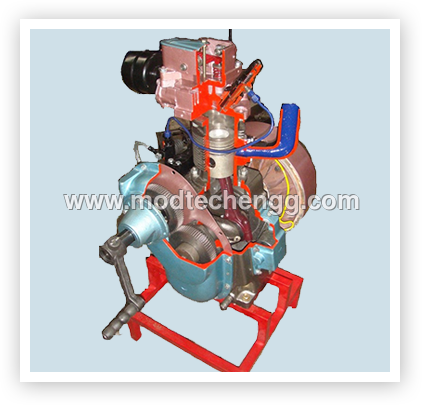
Tell us about your requirement

Price:
Quantity
Select Unit
- 50
- 100
- 200
- 250
- 500
- 1000+
Additional detail
Mobile number
Email


 Send Inquiry
Our Products
- Cut Section Complete Chassis With Electricals
- Cut Section Complete Chassis Without Electricals
- MODEL OF ENGINE ASSEMBLY WITH CLUTCH & GEAR BOX
- CUT SECTION MODEL OF ENGINE
- Engine Assembly with Clutch & Gear Box
- CUT SECTION MODEL OF TWO STROKE SINGLE CYLINDER DI
- Cut section Model Of Gear Box
- Cut section Model of Steering Gear Box
- Cut Section Model of Clutches
- Cut Section Model of Differential with Rear Axle
- Cut Section Model of Brake System
- Cut Section Model of Electrical System
- Cut Section Model of Fuel Supply System
- Cut Section Model Of Suspension System
- Cut Section Model Of Lubrication & Cooling System
- Cut Section Model Of Different Small Components
- Four Stroke Petrol Carburettor Engine For Practice
- Four Stroke Petrol Mpfi Engine Setup For Practice
- 4 Stroke Petrol Carburator Engine With Lpg Setup
- Four Stroke Petrol Mpfi Engine With Lpg Setup
- Four Stroke Diesel Engine Setup
- Two Wheeler Petrol Engine Of Running Condition
- Instruction Boards/Training Platforms
- Training Module For The Engines
- Test Rigs
- Cut section model Of Complete Vehicle
- Cut Section Model Of Engine Working
- Cut section Model Of Different Automobile Parts
- Cut Section Model Of Two Wheeler Aggregator
- Practice/ Running Engine Setup
- Tool And Equipments
- Model Of Auto Electricals
- Garage Tools & Equipments
- Cut Sectioned Engine Assembly With Clutch & Gear
- Exhibition Models

Plot No. 95, Behind Omex Auto, Bommasandra Jigani Link Road, Jigini Post, Bengaluru - 562105, Karnataka, India

Mr Sunil J.
(Partner)
Mobile :08045479896
 Send Inquiry
 Send SMS
Developed and Managed by Infocom Network Private Limited.
